
REPORT OF THE TRAINING WORKSHOP
OLIFANTS RIVER LODGE, MIDDELBURG, 14 – 17 OCTOBER 2025

Narrative report
As South Africa advances its just energy transition, coal-dependent provinces like Mpumalanga face both social and economic transformation. For women in mining and mining-affected communities, this transition presents challenges but also new opportunities in emerging green sectors such as circular economy, climate-smart agriculture, renewable energy, and eco-tourism.
The International Training Centre of the ILO (ITCILO), in partnership with the South African Women in Mining Association (SAWIMA), National African Federated Chamber of Commerce and Industry (NAFCOC), and Indalo Inclusive, organized a 3.5-day training workshop at Olifants River Lodge in Middelburg from 14 to 17 October 2025. The activity formed part of the South Africa Just Energy Transition Jobs First (SAJJOF) project, implemented with the Mpumalanga Green Cluster Agency (MGCA) and the Mpumalanga Department of Agriculture, Rural Development, Land and Environmental Affairs (DARDLEA), with support from the African Development Bank.
The workshop gathered 35 participants, mainly women entrepreneurs and leaders from SAWIMA and NAFCOC, to explore practical ways to reposition themselves within the green economy. It aimed to strengthen participants’ understanding of green-sector opportunities, enhance their entrepreneurial and financial readiness, and build institutional strategies to support women’s participation in the just transition.
The workshop used a highly participatory and experiential approach, combining short technical inputs with storytelling, group discussions, role plays, mapping exercises, and live case studies. Sessions were cofacilitated by Linda Deelen (ITCILO) and Vivian Phetla (Indalo Inclusive), ensuring an inclusive, context-specific, and practice-oriented learning process.
Day 1 – Setting the Scene
The first day focused on listening and mapping participants’ experiences. After a socio-metrics exercise on the green economy, participants spoke about their expectations for the workshop.
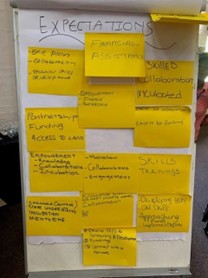
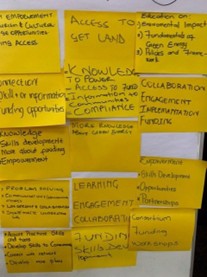
Ms. Duduzile Sibiya, Just Transition Coordinator Mpumalanga Province, delivered welcoming remarks, setting the tone for the discussions on why this training was timely for women in Mpumalanga’s mining regions. Her presentation highlighted the socio-economic transformation underway in the province and the need for women’s economic empowerment in the green transition.
This was followed by contributions from Ms. Freddah Nonkululeko Ngobeand and Ms. Clarah Dube, who emphasized SAWIMA’s and NAFCOC’s roles in championing women’s entrepreneurship and access to opportunities.
Participants then engaged in a sharing circle, identifying the realities, challenges, and ideas of women entrepreneurs in their communities. A mapping exercise helped visualize participants’ current activities, challenges and aspirations within the green economy. The participants also benefited a live case study presented by Ms. Joana Ngele, a local fish farmer, who shared her journey into aquaculture and how green innovations have strengthened her business model.
Day 2 – Opportunities in the Green Economy
Day two explored sectoral opportunities across the green economy, guided by ITCILO’s presentation “Opportunities in the Green Economy”. The session introduced participants to key sectors such as the circular economy, climate-smart agriculture, renewable energy, eco-tourism, and sustainable services, emphasizing the triple bottom line of people, planet, and profit. Through group discussions and case studies, participants analyzed how green enterprises create value and local jobs while addressing environmental challenges. Case studies included Ms. Thandi Nkosi, who established EcoGrow Solutions to supply organic inputs for smallholder farmers; and Ms. Lerato Mahlangu, who built Green Grain Creations, transforming wood waste into home décor products.
Participants brainstormed on opportunities in the different subsectors of the green economy. The discussions underscored the diversity of green business opportunities, from recycling and upcycling to biogas, ecotourism, and renewable energy value chains, and encouraged participants to link their business ideas to social and environmental impact.

Participants also heard from a woman entrepreneur incubated by Indalo Inclusive, working in sustainable agriculture, who shared her experience of receiving mentoring and market access support.
Day 3 – Strategies for Women’s Empowerment
The third day focused on skills development, business support, and financial readiness. In the morning session, participants took part in a skills audit exercise based on a checklist for green and inclusive enterprises, reflecting on their technical, entrepreneurial, and soft skills. The exercise helped identify individual strengths and collective gaps, reinforcing that women already possess many transferable skills relevant for the green transition.
This was followed by two key thematic sessions:
- Enterprise Support Organizations (ESOs) – A presentation on the South African entrepreneurial ecosystem introduced participants to support mechanisms offered by organizations such as Indalo Inclusive, Mpumalanga Green Cluster Agency, Small Enterprise Development and Finance Agency (Sedfa), Fetola, and the Industrial Development Corporation (IDC)
- Access to Finance for SMMEs – Using the Financial Support Checklist. Participants learned what documentation and business planning elements are required to access funding from financial institutions. They discussed practical steps for preparing bankable and “green” business plans.
The afternoon included a panel discussion with Mr. Mdakana Lwazi from MGCA and Vivan Pethla from Indalo Inclusive, who outlined available programmes supporting women entrepreneurs. Participants actively engaged with the presentations, sharing their experiences and identifying collaboration opportunities.
Day 4 – Action Planning and Way Forward
The final half-day was dedicated to translating learning into concrete next steps. Participants worked on their take-away points, their plans to improve as entrepreneurs and their plans to grow their businesses in the green economy. Plans included ideas such as forming green cooperatives, piloting recycling microenterprises, developing mentorship networks, and strengthening links with local ESOs.
Certificates of participation are awarded digitally through the ITCILO certification system.
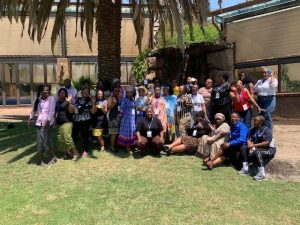
Group picture
BUILDING WOMEN’S PATHWAYS INTO THE GREEN ECONOMY
OLIFANTS RIVER LODGE, MIDDELBURG, 14 – 17 OCTOBER 2025
| DAY 1: SETTING THE SCENE | DAY 2: OPPORTUNITIES IN THE GREEN ECONOMY | DAY 3: STRATEGIES FOR WOMEN’S EMPOWERMENT | DAY 4: ACTION PLANNING |
| Opening and introductions | Circular economy: recycling, waste-to-profit models | Skills development: what women need to succeed in a green and inclusive economy | Action plan development:
projects, partnerships, advocacy |
| TEA BREAK | TEA BREAK | TEA BREAK | TEA BREAK |
| SAWIMA and NAFCOC in the green economy: Why this training now | Climate-smart agriculture and agro-/aquaponics | Business support: incubation, mentoring, cooperatives | Sharing and commitment session |
| LUNCH | LUNCH | LUNCH | |
| Sharing circle: Women’s current realities, ideas and obstacles | Green hydrogen and renewable energy value chains | Access to finance: grants, loans, partnerships | |
| TEA BREAK | TEA BREAK | TEA BREAK | |
| Mapping exercise: Where are we today? | Eco-tourism and cultural heritage opportunities | Guest panel: Business support organizations |

