
REPORT OF THE TRAINING WORKSHOP FOR BUSINESS SUPPORT ORGANIZATIONS
MBOMBELA, MPUMALANGA PROVINCE, 17 – 19 NOVEMBER 2025


Narrative report
Mpumalanga Province is undergoing a significant transformation as South Africa advances its shift from coal-based development to a cleaner and more sustainable economy. This transition is expected to reshape local markets, create new sectors, and generate opportunities for business growth, while also presenting challenges for micro, small and medium sized enterprises. Business support organizations are central in equipping enterprises to navigate this transition, promote greener business models, and stimulate job creation in emerging green sectors.
The International Training Centre of the International Labour Organization delivered a three-day capacity building workshop in Mbombela from 17 to 19 November 2025. The activity was organized within the South Africa Just Energy Transition Jobs First project, supported by the African Development Bank and implemented together with the Mpumalanga Green Cluster Agency and the Mpumalanga Department of Economic Development and Tourism. The workshop brought together managers, trainers, consultants, policy makers, and representatives of financial service providers who contribute to enterprise development in Mpumalanga.
The objective of the training was to strengthen the capacity of business support organizations to understand and promote green business development and to guide MSMEs in their green transition. The programme combined conceptual inputs, case studies, tools, and interactive group exercises to build a shared vision for an enabling environment that supports green business growth.
Day 1 – Setting the Scene
The workshop opened with introductions and the sharing of participants expectations, creating a collaborative learning environment. The first technical session introduced the global environmental challenge and the broader rationale for green transitions, highlighting the increasing importance of sustainability for MSME competitiveness and resilience.
This was followed by an introduction to green business concepts and the business case for adopting greener practices. Participants explored how enterprises can save resources, reduce waste, enhance efficiency, and meet growing market and regulatory expectations.
Day 1 Group Work:
in the afternoon, participants took part in an interactive group realities. Guided by the group work framework provided on Day 1, groups addressed three questions:
- What are the key environmental problems in Mpumalanga
- What do you think is the role of businesses
- What opportunities can businesses leverage to become greener
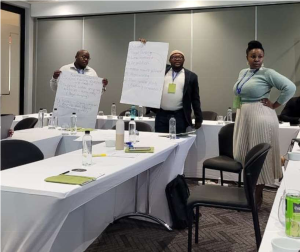
Through this process, participants highlighted issues such as water pollution, waste accumulation, land degradation, and the pressures created by the energy transition. They also identified that businesses can play a pivotal role by adopting cleaner production, investing in resource efficiency, and exploring circular economy solutions. This session initiated a strong analytical foundation for the rest of the programme.
Day 2 – Practical tools for green business support
The second day focused on hands on tools and methods to support business greening. Three sessions introduced participants to practical instruments for identifying greening opportunities at firm level, analysing internal and external drivers, and integrating environmental considerations into business development services.
Participants explored how MSMEs can green their operations in ways that improve profitability and resilience. Examples and discussion demonstrated how BSOs can support behavioural change, facilitate market access for greener products, and connect businesses to relevant partnerships and support mechanisms.
Day 2 Group Work:
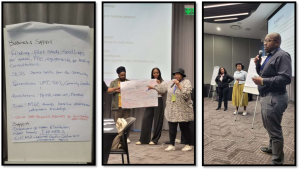
In the afternoon, participants engaged in a more structured opportunity framing exercise using the Green Opportunity and Support Canvas, as presented in the group work document. Each group selected one environmental or economic challenge identified on the previous day and worked through the following steps:
- Describing the problem and identifying where it is most visible in Mpumalanga
- Analysing the root causes at both local and provincial levels
- Identifying who is affected including communities, businesses, and ecosystems
- Proposing a concrete green business opportunity that responds to the challenge
- Identifying the business support required such as skills, funding, infrastructure, partnerships, data, or regulation
- Mapping where such support exists in Mpumalanga and, if missing, where it can be accessed elsewhere
This exercise enabled participants to connect environmental problems to realistic green business opportunities and to understand the role of BSOs in nurturing these opportunities through adequate support and ecosystem coordination.
Day 3 – Sustainable Finance and Green Business Financing
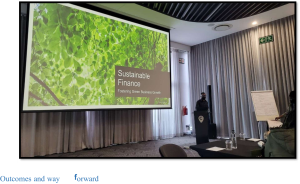
The final day focused on sustainable finance and the financial readiness of enterprises. The morning opened with a presentation by Cerin Maduray, Sustainable Finance Lead at WWF South Africa, who shared insights into the national sustainable finance landscape. His contribution provided a comprehensive overview of sustainable finance developments, the role of financial institutions in promoting environmental sustainability, and current WWF work aimed at strengthening the alignment between finance and green economic development in South Africa. Participants engaged actively with his presentation, raising questions related to financing instruments, risk considerations, and opportunities for MSMEs in the Mpumalanga regio.
This was followed by a session on financing green businesses by Indalo Inclusive, which covered the documentation, planning, and strategic requirements necessary for MSMEs to access finance. Participants discussed how BSOs can enhance the financial readiness of enterprises and support them in developing credible and green oriented business proposals.
By the end of the programme, participants had strengthened their understanding of green business development concepts, learned to apply practical tools for identifying and supporting green opportunities, and improved their knowledge of sustainable finance general concepts and potential access. The group work exercises helped clarify the environmental challenges facing Mpumalanga and the concrete business opportunities that can emerge from them.
Participants expressed a strong interest in continued collaboration, with priorities including a more coordinated support ecosystem, expanded access to green finance instruments, further technical training on enterprise greening, and joint mapping of existing initiatives in the province.
All participants received an official digital certificate of participation issued through the ITCILO certification system.
Group picture

| Monday | 09:00 | 10:00 | Opening and introductions |
| 10:00 | 11:00 | The global environmental challenge | |
| 11:00 | 11:30 | ||
| 11:30 | 13:00 | Introduction to green business | |
| 13:00 | Lunch Break | ||
| 14:30 | 16:00 | Building a conducive business environment for green business growth | |
| 16:00 | 16:30 | ||
| 16:30 | Groupwork: Green business opportunities in Mpumalanga
Province |
||
| Tuesday | 09:00 | 10:30 | Tools for Green Business I |
| 10:30 | 11:00 | ||
| 11:00 | 12:30 | Tools for Green Business II | |
| 12:30 | 14:00 | Lunch Break | |
| 14:00 | Tools for Green Business III | ||
| 15:30 | 16:00 | Tea/Coffee Break | |
| 16:00 | 17:30 | Groupwork: Designing green business initiatives in
Mpumalanga Province |
|
| Wednesday | 08:30 | ||
| 10:15 | 10:30 | Tea/Coffee Break | |
| 10:30 | 12:30 | Financing green businesses | |
| 13:00 | 14:00 | Lunch Break / end of activities |

